
Youth Programs >
Resist, Recycle, Regenerate
Resist, Recycle, Regenerate (RRR) 2025–2026
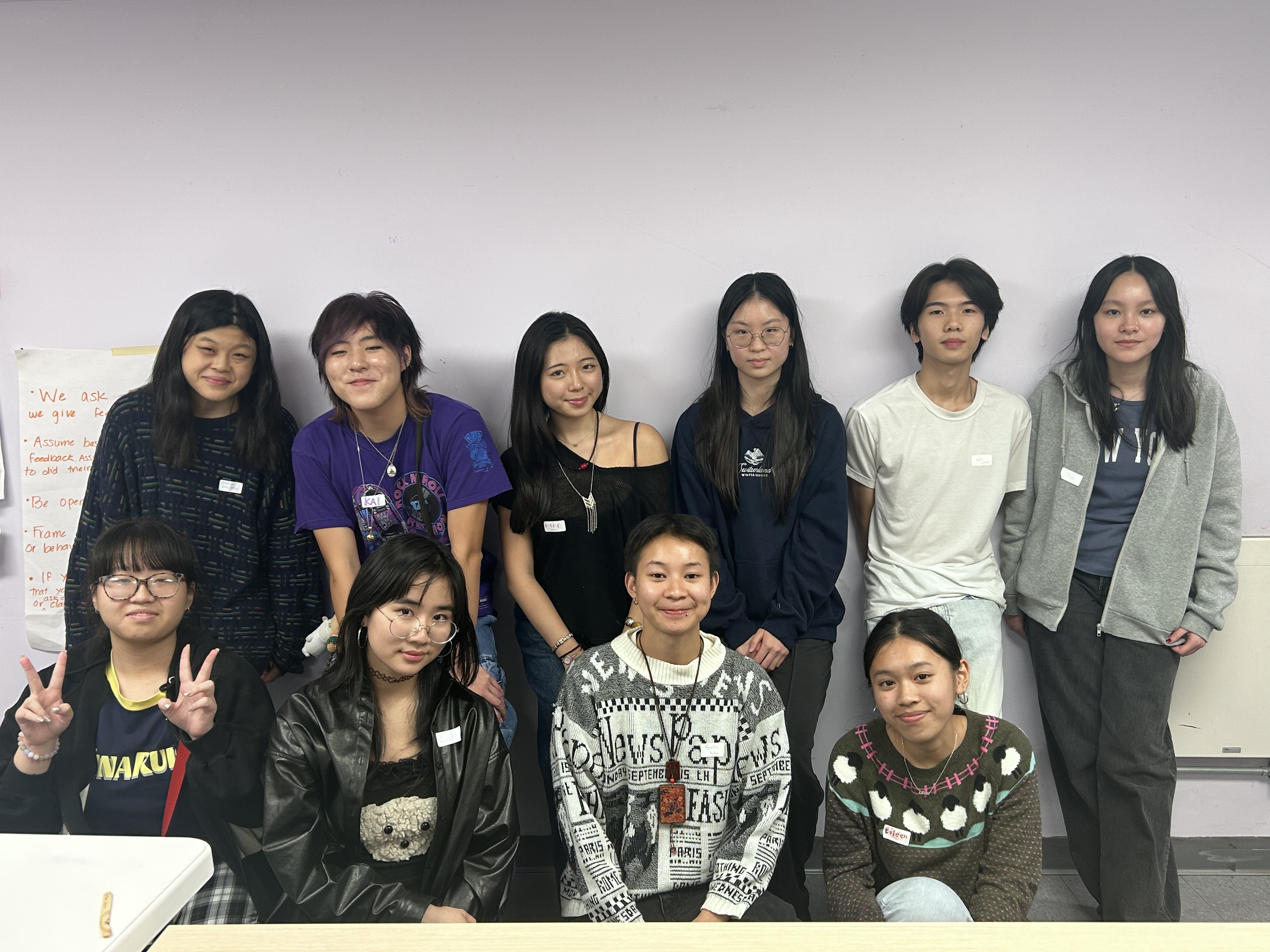
In 2025, Resist Recycle, Regenerate (RRR) welcomed an expanded cohort of 7 fellows. This year’s cohort includes 6 high school students and 1 college student.
2026 Community Engagement Highlights
February 7 — Abrons Arts Afternoon: RRR facilitated family friendly art activities for the Lower East Side community at Abrons Arts Center from 12:00-3:00 pm.
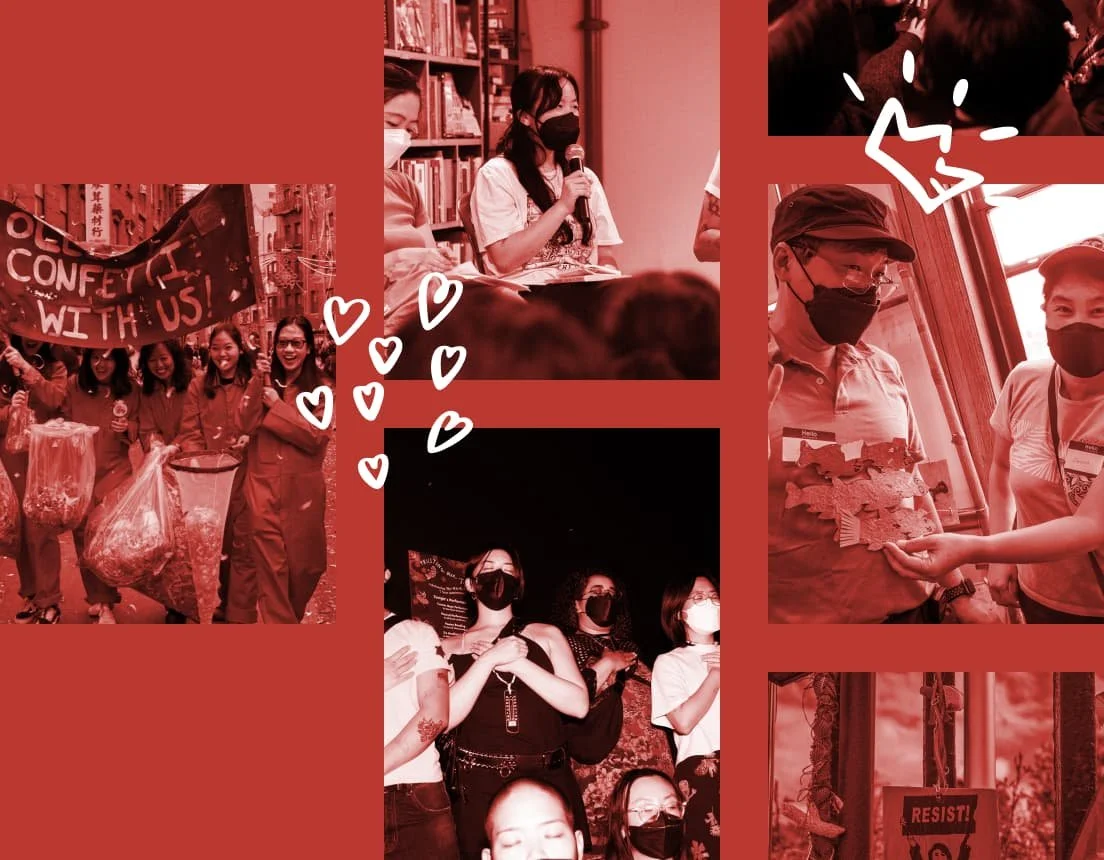
February 14 — From Chinatown, With Love Procession: RRR unveiled their group project inspired by what they learned in Phase 1 and the year of the double fire horse. Read more below!
February 28 — Confetti Collection: We collected discarded confetti on Super Saturday. These materials will be transformed into paper in future workshops led by the cohort.
May 2 - Papermaking workshop: Fellows facilitated papermaking workshop for the Chinatown community at Chatham Square Library.
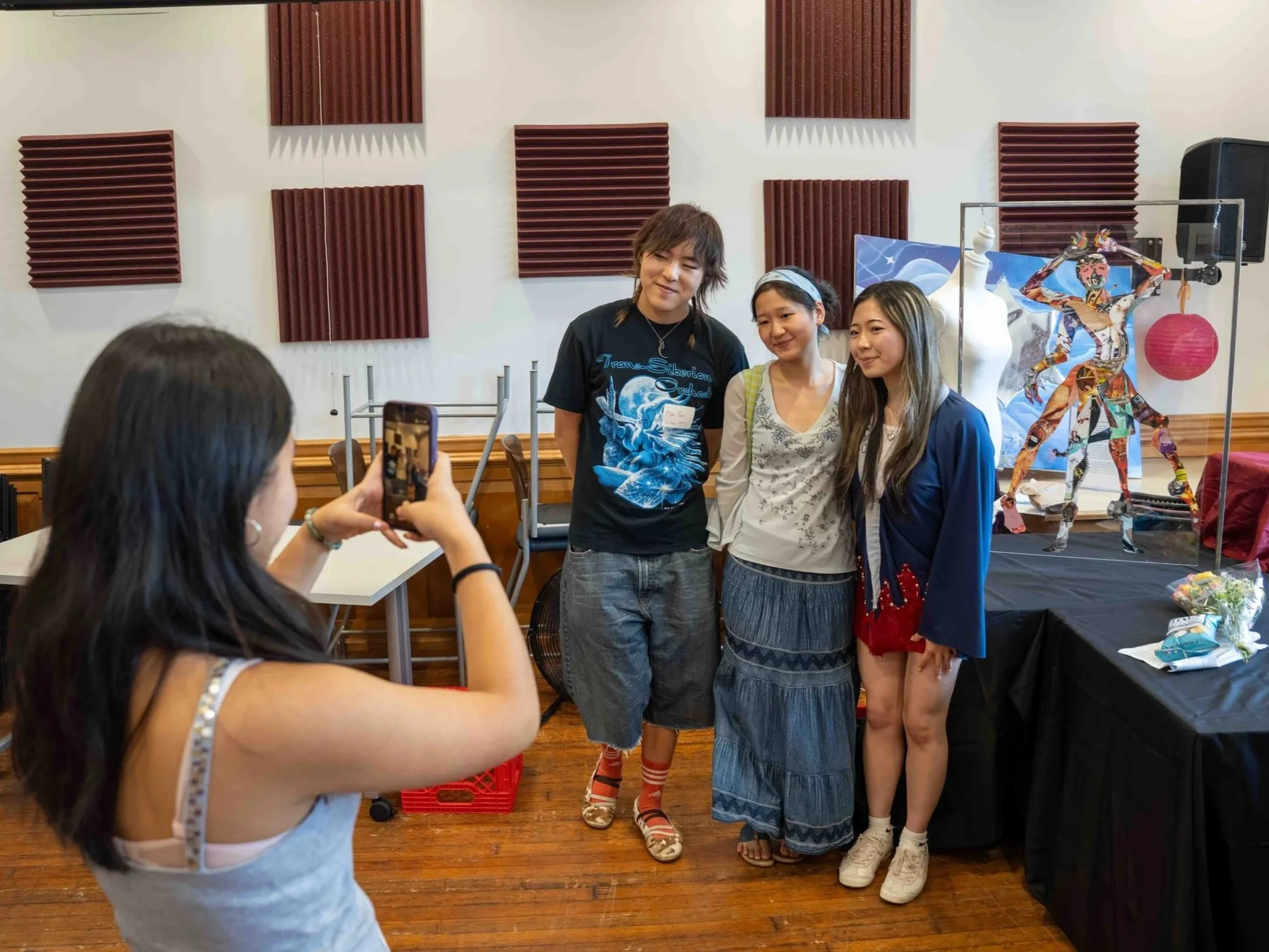
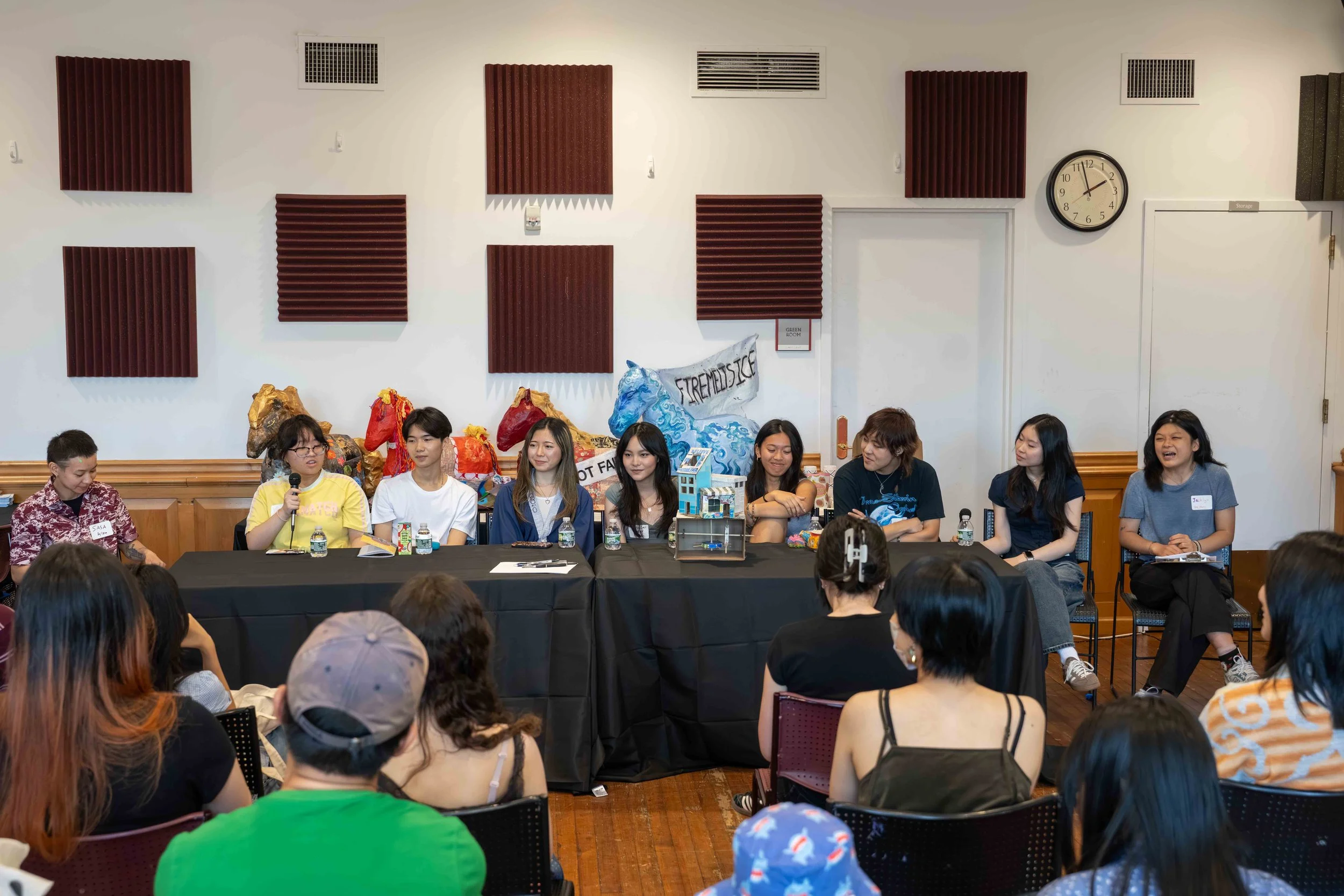
June 13 - Celebrated the Resist Recycle Regenerate cohort at their Final Showcase on June 13 at Chatham Square Library
Final Showcase: During their final showcase, RRR celebrated year of learning, creation, joy, and growth. Through their final projects and panel discussion, the fellows shared their expansive understanding of cultural organizing as not just protest, but also the continued celebration of Chinatown as a living place, sustained by mutual care, intergenerational knowledge, and resistance against cultural displacement. You can learn more about Phase 3 and the cohort’s final project below!
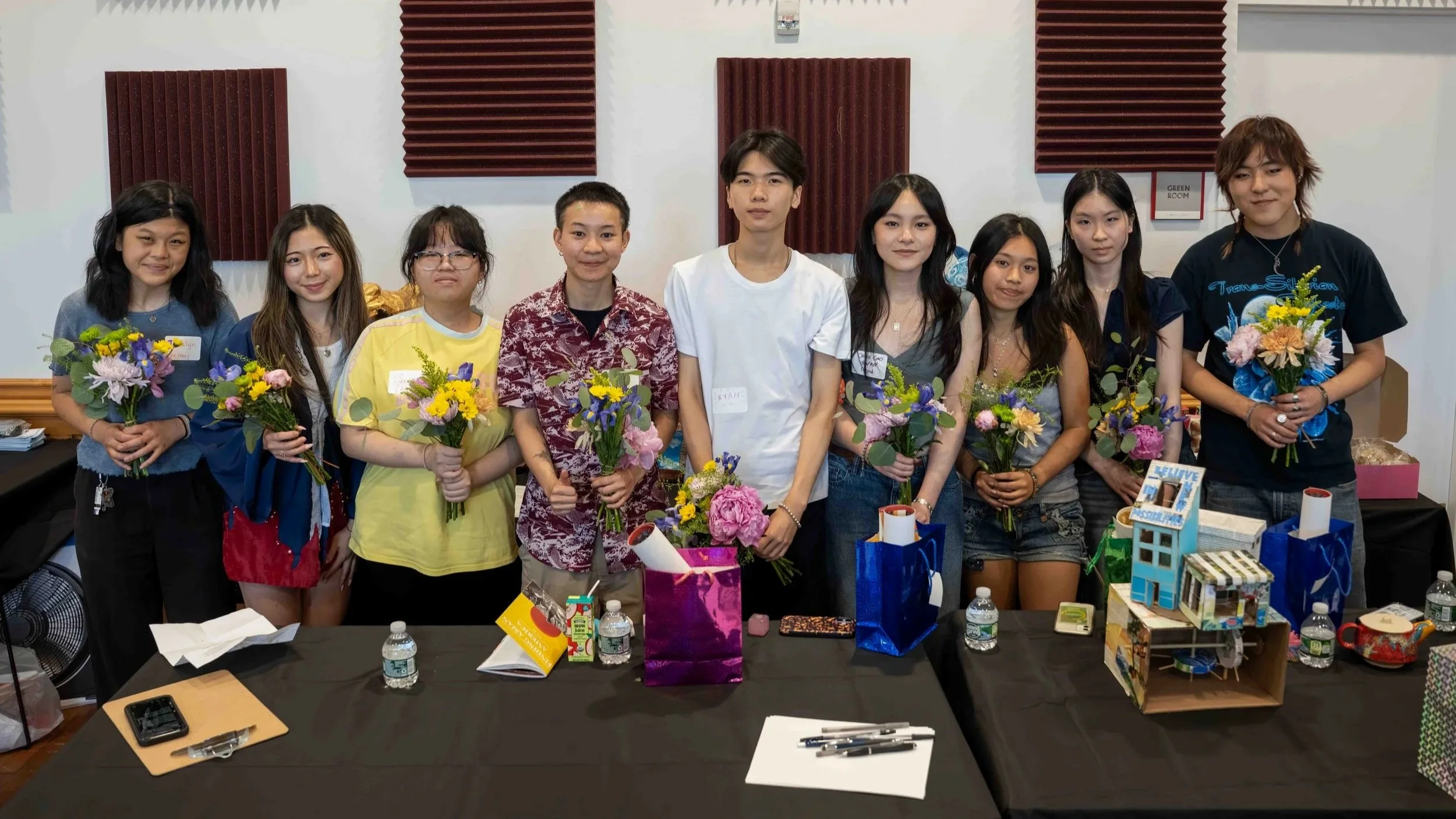
Photos courtesy of Cal Hsiao
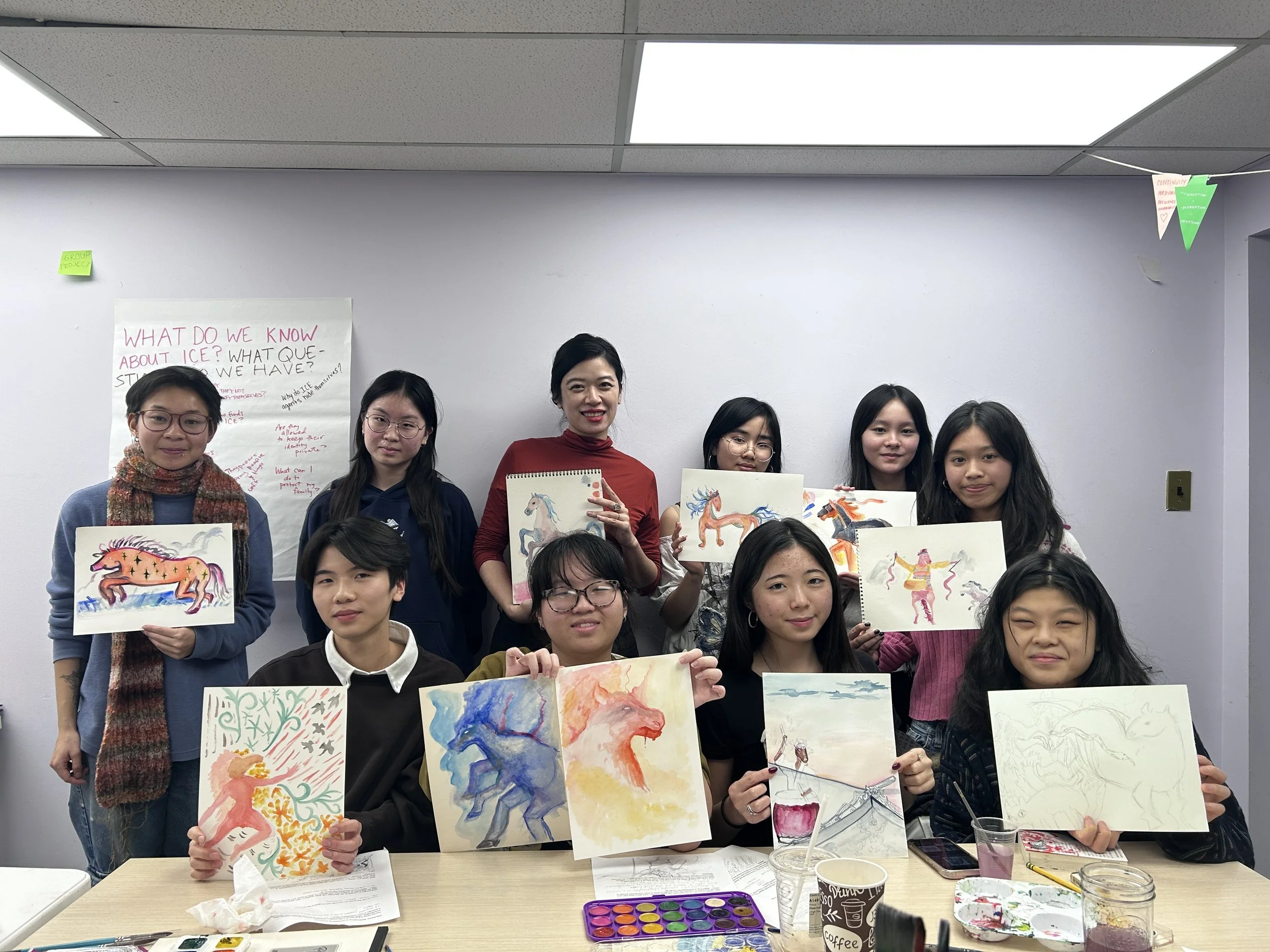
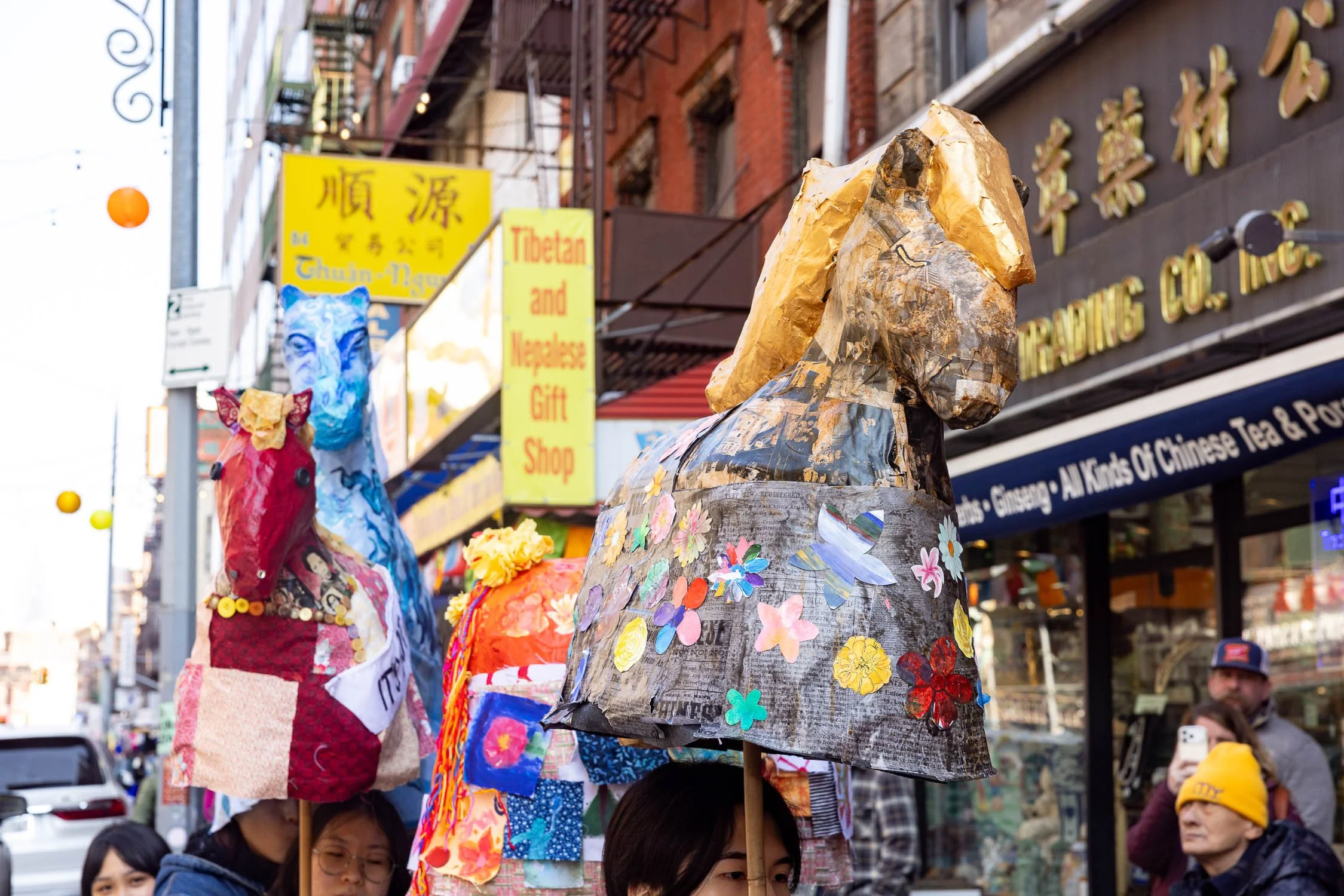
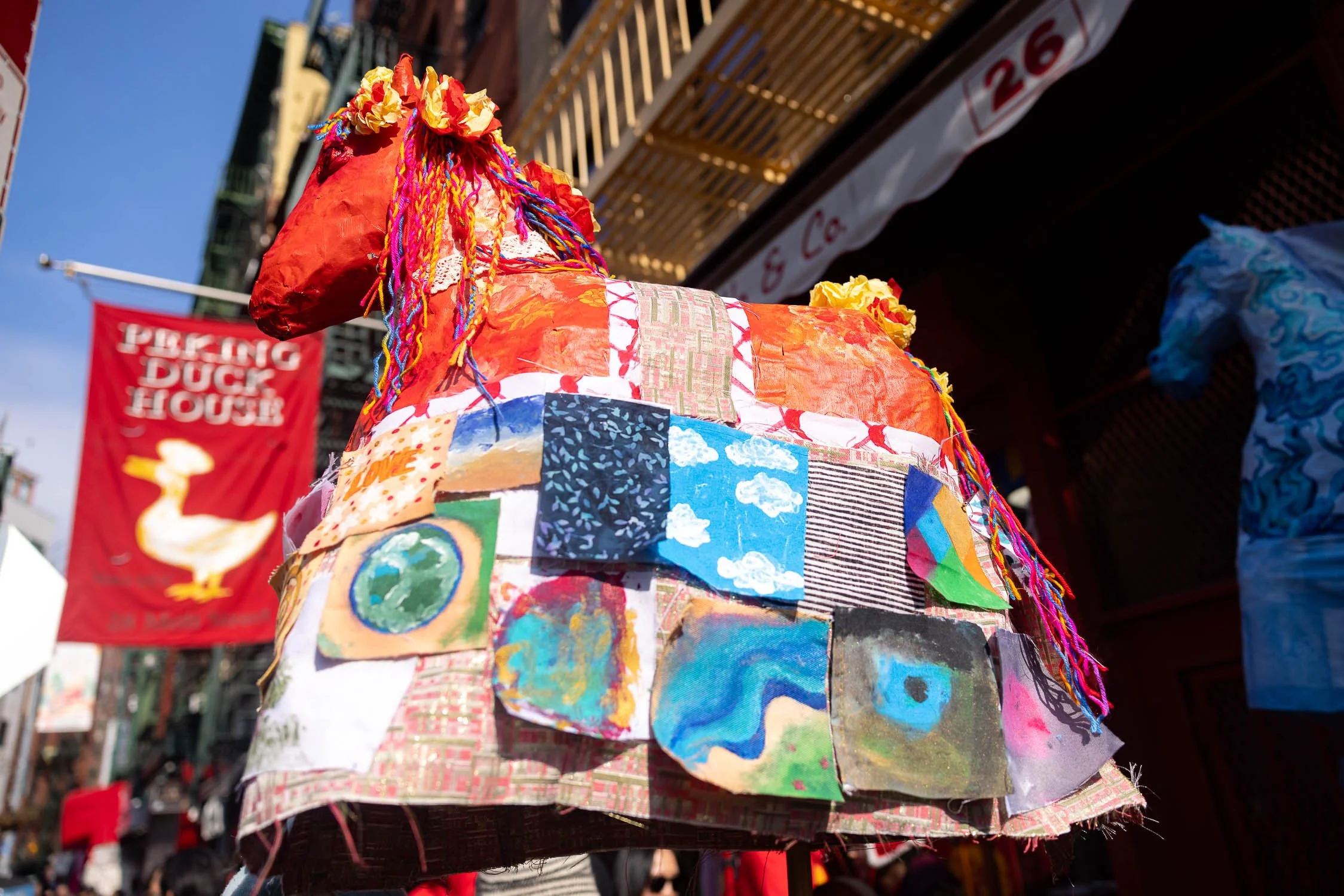
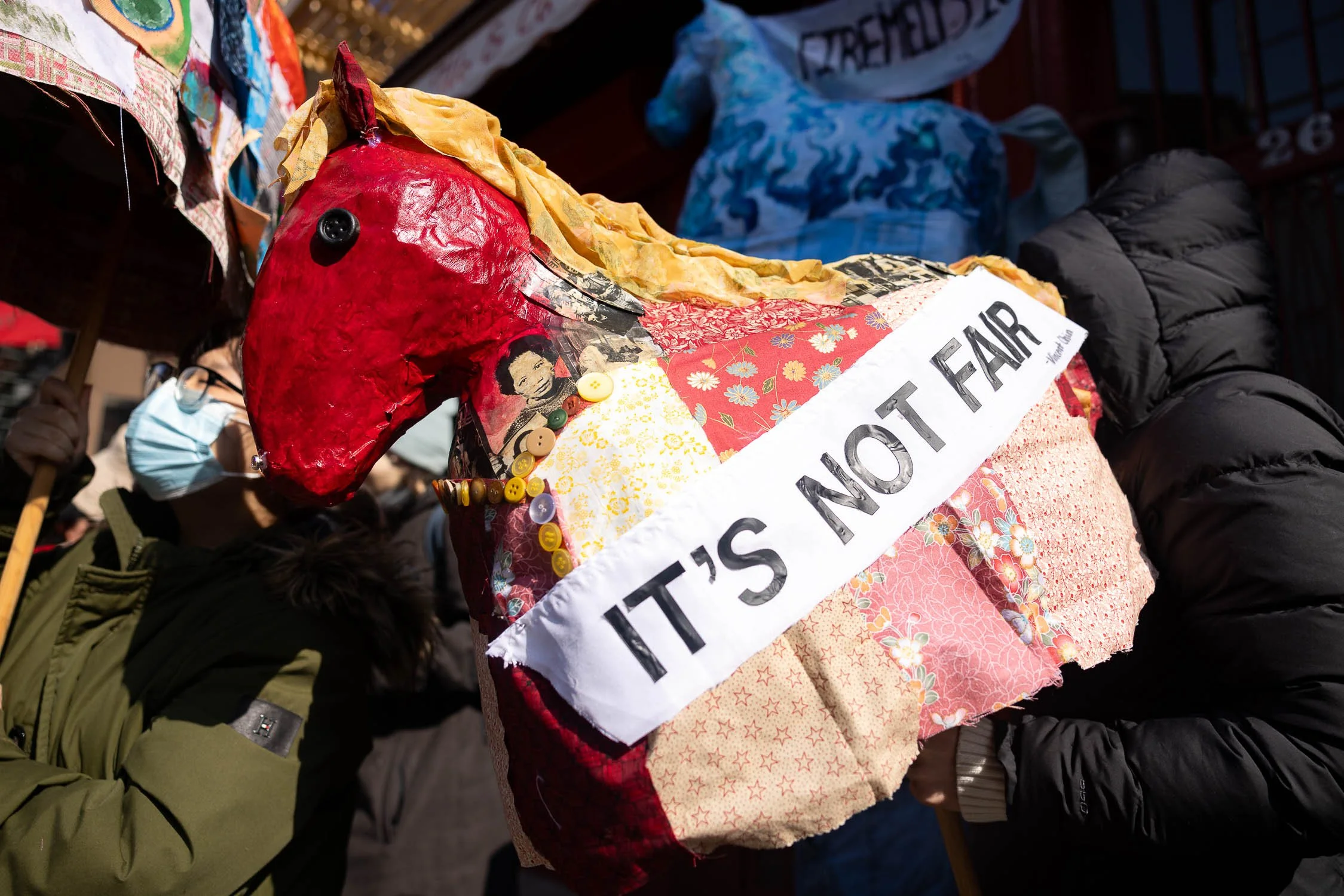
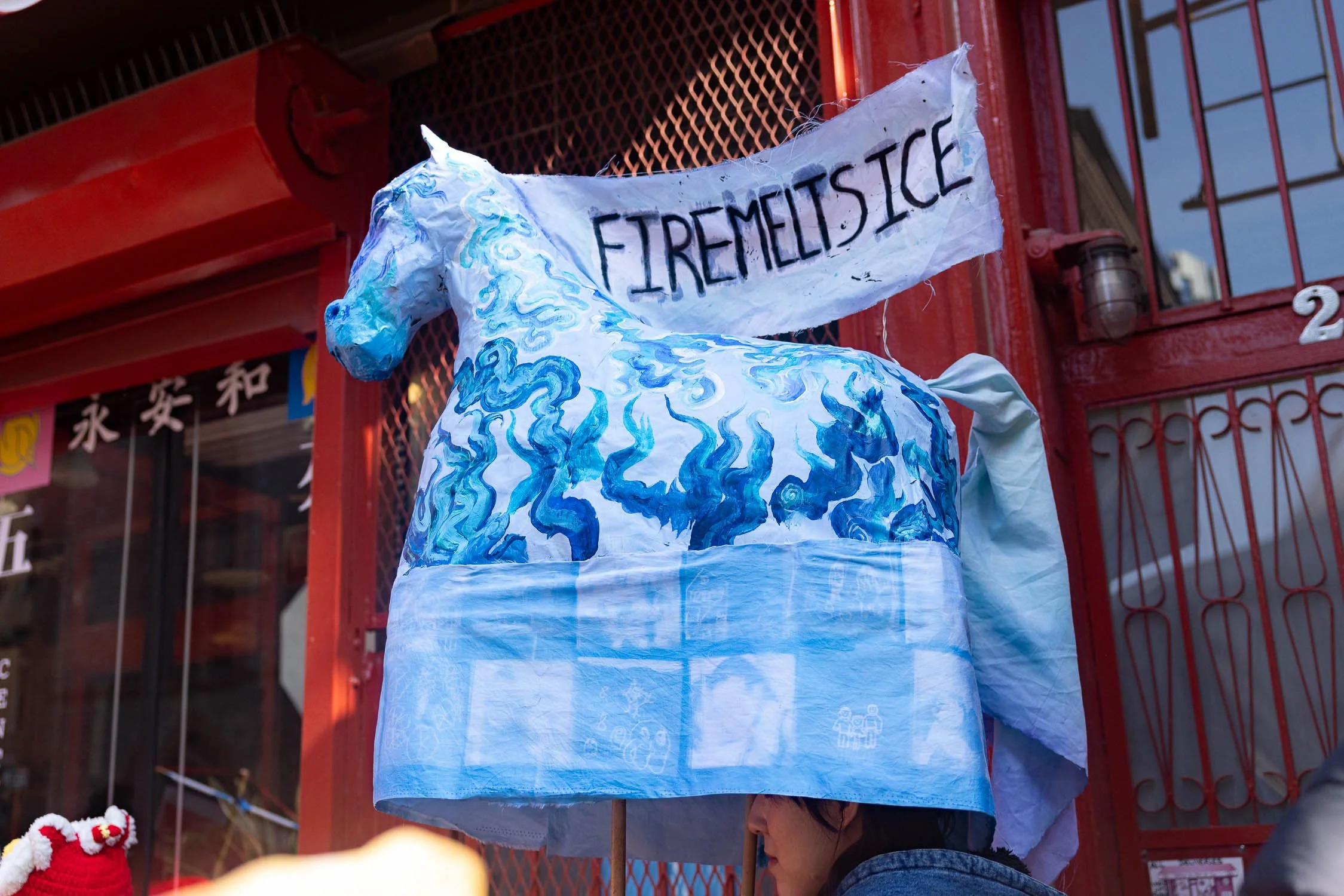
Group Project: In Phase 2 fellows collaborate on a large scale project that they unveil during Lunar New Year festivities. To welcome the year of the fire horse this year’s cohort made 4 fire horse puppets. Each horse articulates a lesson or value from Asian American history that RRR brings to their demands for the present and their vision for the future. The cohort shared their call for action with the community during the W.O.W. The Crowd Street performance. Excerpts from their statement are below.
Cohort Statement
This zodiac year is known for intense passion, action, and transformation. To welcome this energy, we crafted four horses that represent Asian Americans’ past, present, and future. Embodying the 2026 RRR theme of “collective power,” we aspire to ignite our shared histories and rewrite our futures.
Our first horse is named Michelle. She represents Asian American history from the late 18th to early 19th centuries. During this time, hundreds of thousands of Asian immigrants came to the U.S seeking work. They formed Chinatowns across the country and helped build this nation through projects like the Transcontinental Railroad.
This growth was met with intense anti-Chinese discrimination. Events such as the Chinese Exclusion Act of 1882 and the Rock Springs Massacre of 1885 reflect the hostility Asian immigrants faced simply for thriving.
Michelle carries this history of resistance. The body collage features Asian immigrants and their communities, while the cloak is covered in harmful rhetoric, symbolically weighing the body down. Still, the flowers on the cloak remind us that Asian Americans continue to grow and resist.
Our horse calls on us to remember this history, to hold onto the struggles Asian Americans have faced and to move forward with strength and resilience.
Our beloved horse Xiaoleen embodies the spirit of peace inspired by resistance in the mid-1900s, a period of global violence, from the Nakba to the Vietnam War. The U.S. imperialist war machine tries to convince us that destroying other communities grants us safety. There is no moral victory in wars– only profit at the expense of lives. We urge divestment from weapon manufacturers and for our tax-dollars to go towards education and health-care instead of the Military-Industrial Complex.
The same imperialist agenda that devastates lives abroad oppresses us here at home. The mid-20th century saw the emergence of multiracial civil rights groups. Xiaoleen’s colorful braids honors the intertwined solidarity between different communities.
We invited people of different ages to draw what peace looks like to them. Xiaoleen’s quilt is the creation of our shared visions. For us, peace looks like a liberated future without war, where children are safe and flowers can grow.
“It’s not fair.” These were the final words of 27-year-old Vincent Chin, who was murdered amid high anti-Asian sentiment in Detroit in 1982. The same year Vincent Chin died, twenty thousand garment workers marched through Manhattan’s Chinatown to demand livable working conditions. During an era of anti-Asian sentiment and cold indifference, our community rose up to prove that our lives are not disposable. Our third horse honors Vincent Chin and the organizers of the International Ladies’ Garment Workers’ Union. Whether we’re in Detroit or a garment factory in Chinatown, our safety and survival depend on standing together.
While our first three horses honor our history, our last horse was built to defend our futures. Our horse is blue, the color of the hottest flame, because right now is our time to erupt with outrage at injustice and cruelty. At least 9 people have already been murdered by ICE in 2026: Alex Pretti, Renee Good, Keith Porter Jr, Geraldo Lunas Campos, Victor Manuel Díaz, Parady La, Luis Gustavo Núñez Cáceres, Luis Beltrán Yanez-Cruz, and Heber Sanchez Domínguez. At least 32 people have died in ICE facilities just this year.
Horses are independent but deeply loyal and protective animals. Right now, it is our responsibility to embody the fire horse through change, courage, and action. We must fight for our homes, our neighbors, and our lives with unrelenting fury. You may feel powerless right now, but know that there are so many actions you can take. You can care for the people around you and take part in strikes and protests. You can call your state senator and tell them to sign the New York 4 All Act and abolish ICE. You can donate to organizations like the ACLU, Make the Road New York, Immigrant Defense Project, or the NY Immigration Coalition. Our love, compassion, and resistance are what keep us safe, not fear and mass deportation.
As youth, it is a tall order to imagine and strive for a world of greater equality, justice, and healing. We built these horses to trace our current fury and resistance to a legacy of advocacy and change-making, which we hope will inspire not only anger but also hope. Fire is scorching and passionate and nurturing and life-bringing. Fire will always melt ice.
Photos courtesy of Sean Chee
RRR 2025–2026 Leadership Team
-
Bridget Li
Coordinator
-
Sasa Yung
Co-leader
-
Jacklyn Chuang
Co-leader
RRR 2025–2026 Fellows
-
Xiaoying
Fellow
-
Ryan
Fellow
-
Cindy
Fellow
-
Olivia
Fellow
-
Eileen
Fellow
-
Kai
Fellow
-
Momo
Fellow
Notes from RRR Year 2025–2026:
Phase 2 (February-April):
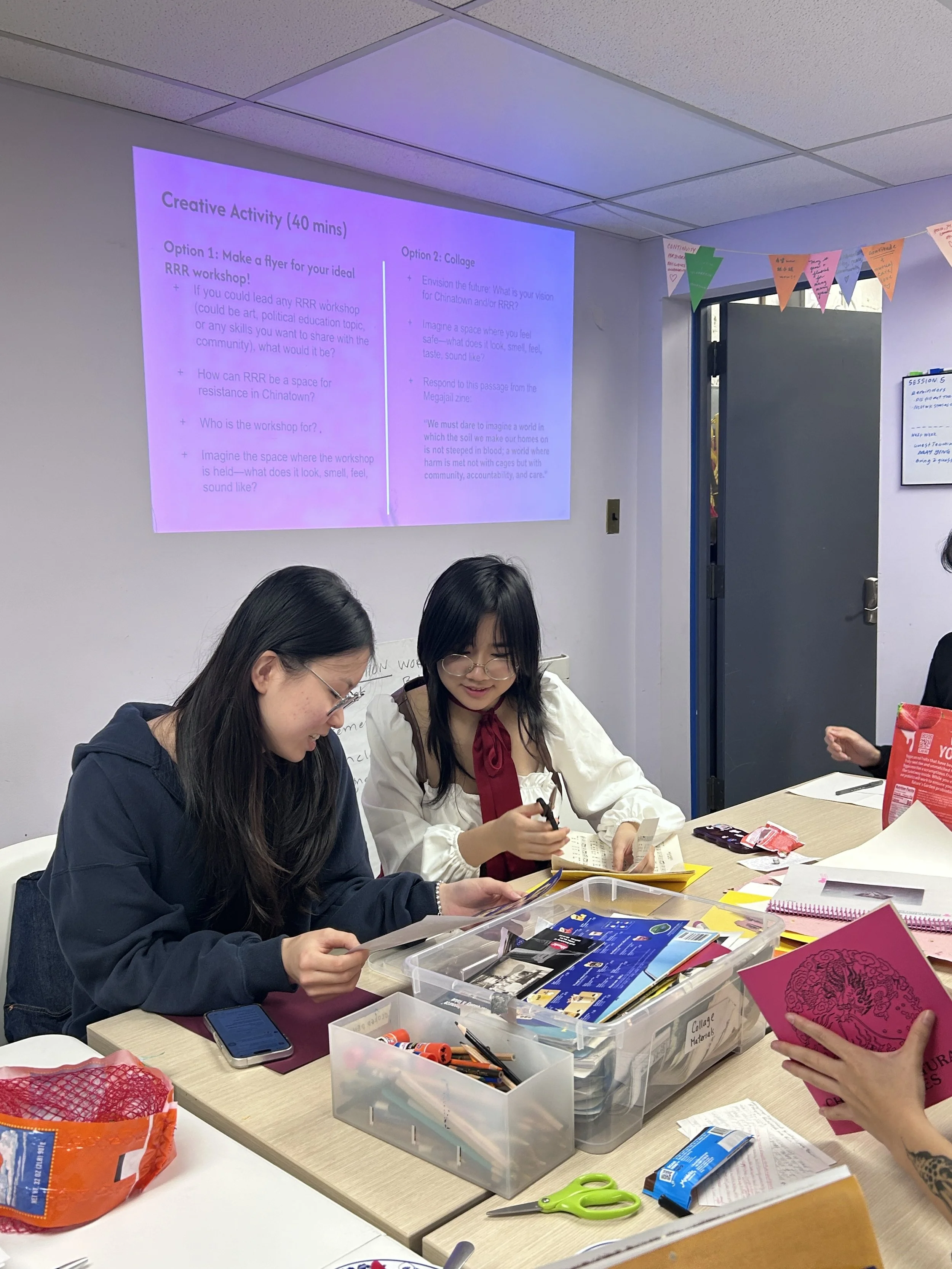
Phase 2 centered community-based work and collective action. The cohort debuted their group project during the From Chinatown With Love procession, facilitated art activities for children and families at Abrons Arts Afternoon, and denounced ICE in their speech during WOW the Crowd Street Performance: Love as Resistance. In the new year they collected confetti during Super Saturday, attended an anti-ICE protest, and facilitated a papermaking and solidarity letter-writing workshop for friends and family.
Phase 3 (May-June):
In Phase 3 of RRR, fellows led a papermaking workshop at Chatham Square Library. Community workshops are always a full circle moment for the cohort, from learning papermaking in the fall, to developing their leadership and facilitation skills and collecting confetti during Lunar New Year, to finally sharing their skills with community members of all ages. During the Final Showcase, we celebrated the RRR cohort by displaying their final projects and hearing about their experiences during the panel discussion.
Phase 1 (October–January):
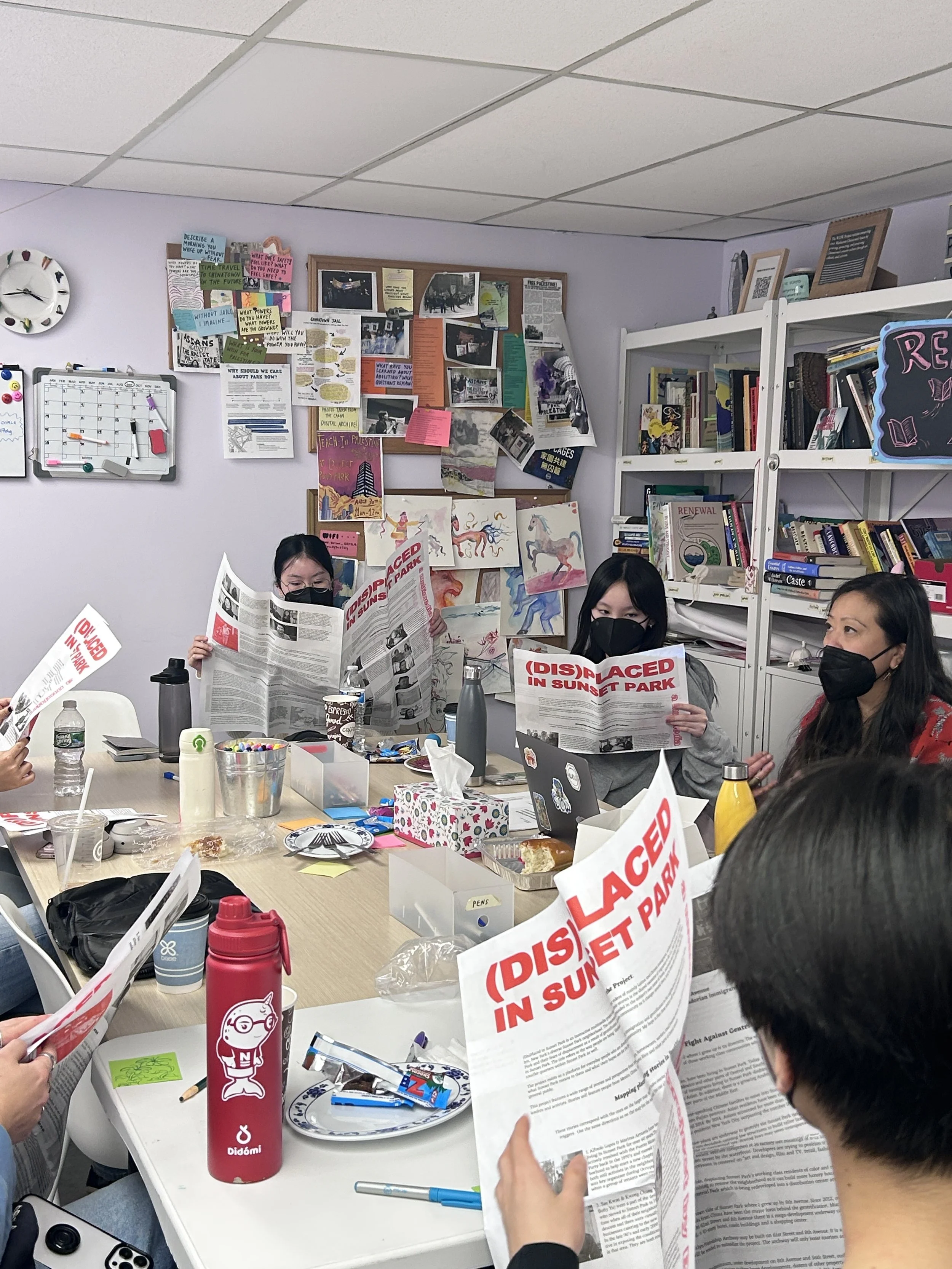
Phase 1 of Resist Recycle Regenerate (RRR) has come to a close, marking the start of our 8th year with a newly expanded cohort of eight fellows! In 2025, we welcomed this group alongside a dedicated leadership team of returning alumni and new staff, whose care and commitment set the tone for the year ahead. Over eleven sessions, fellows created community agreements, made paper, and learned about Asian American history.
The first 3 months of the program centered on connection and collective inquiry through art-making and discussion on the intersections of ICE, gentrification, and the prison-industrial complex. In December, fellows began creating a group project inspired by the Year of the Fire Horse. We extend our deepest gratitude to our incredible guest teaching artists—Gary Lum, May Ying Chen, Jia Sung, Betty Yu, and Diane Wong—whose wisdom and creativity enriched the cohort’s learning.
RRR Year 2025–2026 Final Projects
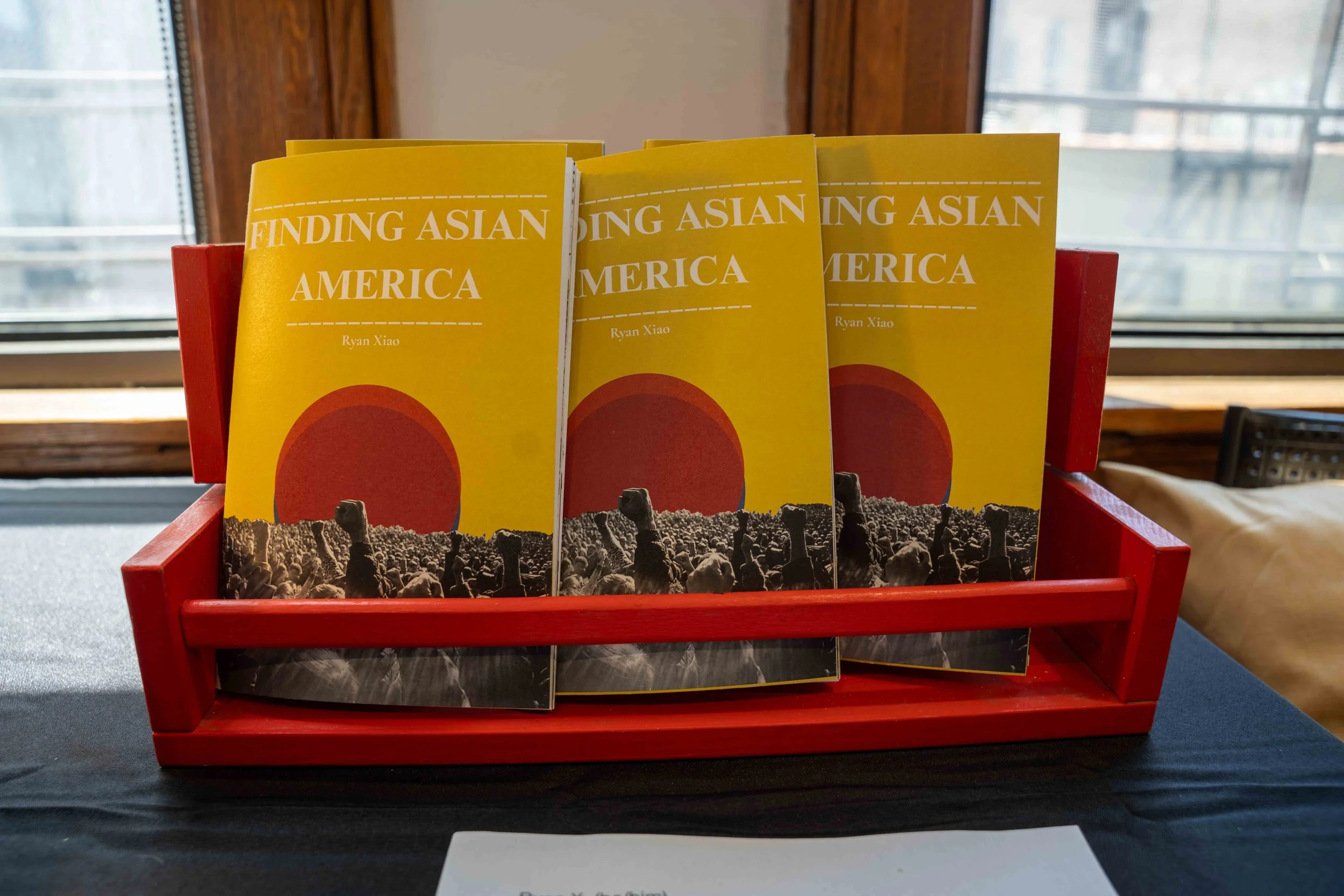
Finding Asian America by Ryan X. (he/him)
Printed digital zine; 5.5” x 8.5”
Finding Asian America dissects what it means to be Asian American in various contexts, drawing from challenges with internal struggles with my own identity and inspired by larger, collective Asian American struggles throughout history. Our current understanding of the term “Asian American” is rooted in a racial-national perspective—a simple categorization of individuals who have ancestry or are from Asia that have come to reside in America. But, as I try to explore in Finding Asian America, there is so much more that comes with the term “Asian American” than just a group of people.
Each spread presented within the project is intentional. The book features collages made from images spanning various decades of Asian American history, including illustrations, designs, flowers with specific meanings, and scraps from revolutionary newspapers advocating for Asian American rights. I attempted to not just create a series of words, but a cultivated experience through these elements of collage, personal writing, and illustration. I attempted to create something authentic to myself and my view of the Asian American experience.
Literature is the want to be seen, and seeing is the greatest act of intimacy. I hope you will see me here, somewhere in the midst of it all.
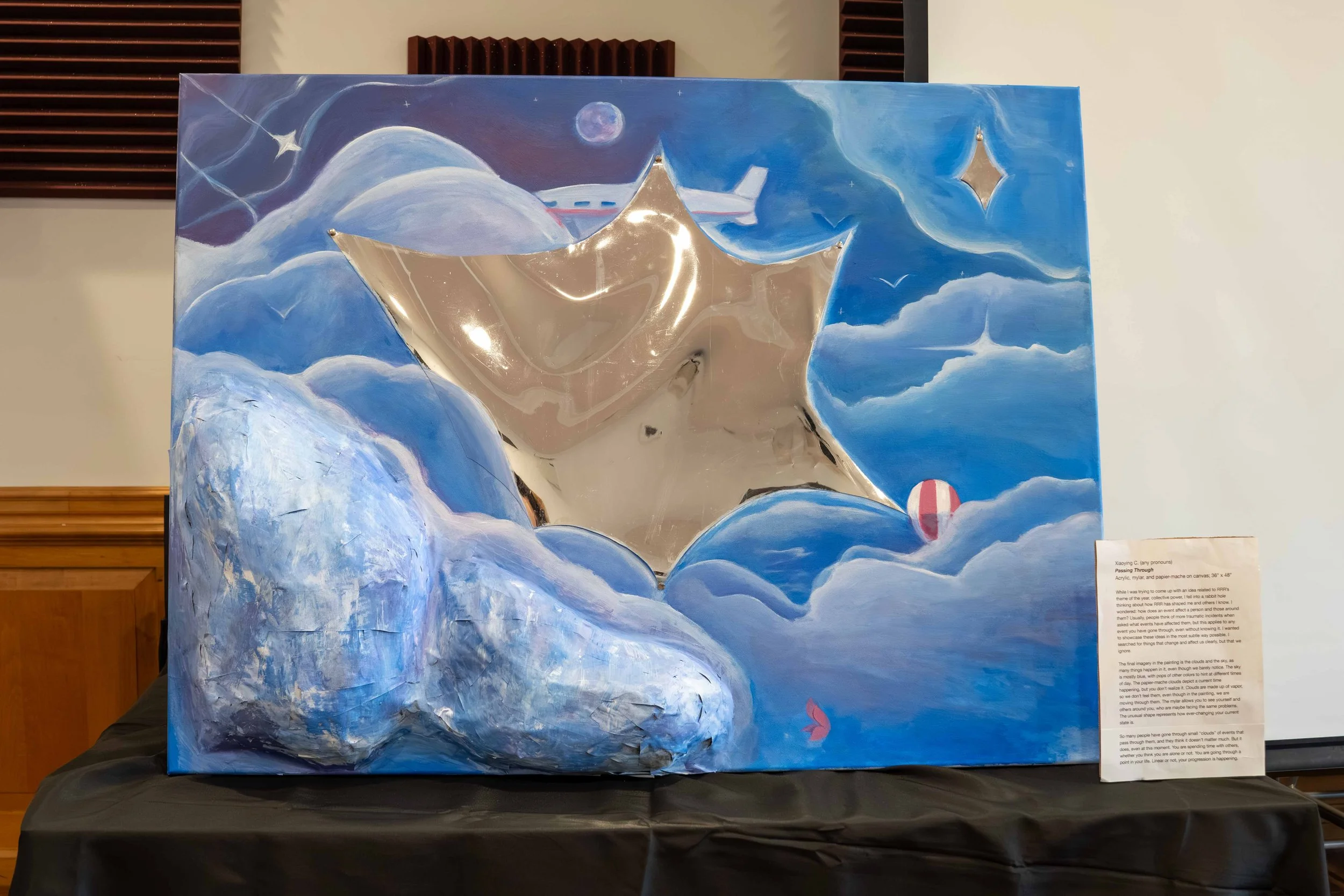
Passing Through by Xiaoying C. (any pronouns)
Acrylic, mylar, and papier-mache on canvas; 36” x 48”
While I was trying to come up with an idea related to RRR’s theme of the year, collective power, I fell into a rabbit hole thinking about how RRR has shaped me and others I know. I wondered: how does an event affect a person and those around them? Usually, people think of more traumatic incidents when asked what events have affected them, but this applies to any event you have gone through, even without knowing it. I wanted to showcase these ideas in the most subtle way possible. I searched for things that change and affect us clearly, but that we ignore.
The final imagery in the painting is the clouds and the sky, as many things happen in it, even though we barely notice. The sky is mostly blue, with pops of other colors to hint at different times of day. The paper-mache clouds depict a current time happening, but you don’t realize it. Clouds are made up of vapor, so we don’t feel them, even though in the painting, we are moving through them. The mylar allows you to see yourself and others around you, who are maybe facing the same problems. The unusual shape represents how ever-changing your current state is.
So many people have gone through small “clouds” of events that pass through them, and they think it doesn’t matter much. But it does, even at this moment. You are spending time with others, whether you think you are alone or not. You are going through a point in your life. Linear or not, your progression is happening.
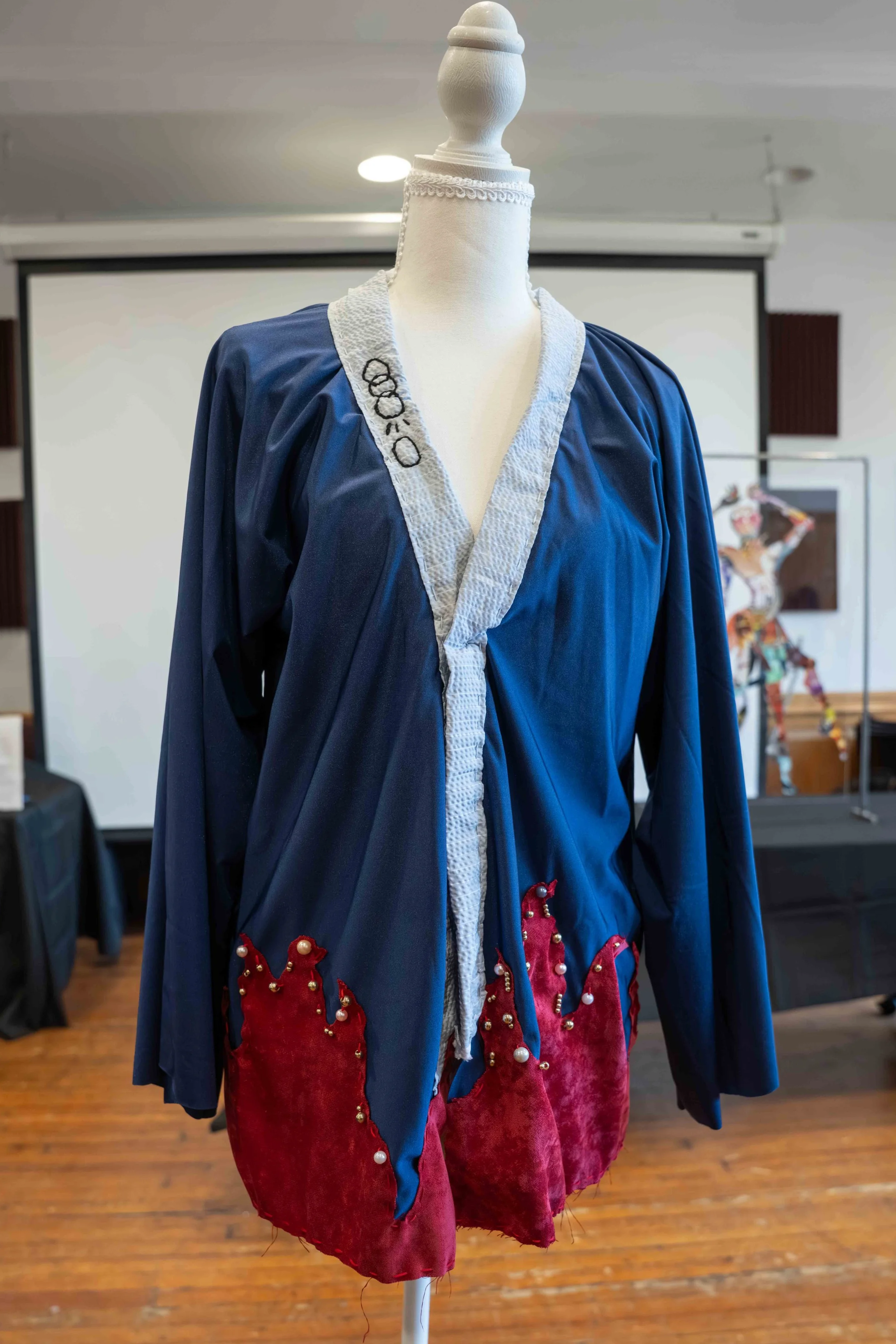
Threaded Thrums by Momo I. S. (she/her)
Hand-sewn happi coat, upcycled fabric
Drawing from the use of taiko drumming in political movements, Threaded Thrums is a taiko costume-inspired coat advocating for peace, for abolition of the prison industrial complex, and against ICE. Reminiscent of the happi, a traditional coat often worn in taiko performance, Threaded Thrums is a contemporary rendition of taiko attire responding to present-day issues. Like taiko’s use in the Burakumin and AAPI movements, it can be used in modern-day protests like those against ICE and for abolition.
Though taiko drumming has existed in Japan since the fifth century as accompaniment in ancient imperial courts, it became the folk-drumming ensemble style it is today during the post WWII revitalization of Japan and the Japanese American Civil Rights movement. Scholars Tamiko Cavey and Yoshitaka Terada argue that Taiko was an instrumental tool in the Asian American Civil Rights Movement and the Japanese Burakumin movement.
Although taiko attire is not often political, my piece is an artistic rendition of the happi, envisioning how taiko drumming could be used by the Chinatown community. With the kanji for “peace” on the back, fire symbolizing melting “ICE” on the bottom, and broken chains symbolizing abolition of the Prison Industrial Complex on the collar, Threaded Thrums embodies how taiko has been used in decades past and how it may be used in the present day to create noise in Chinatown.
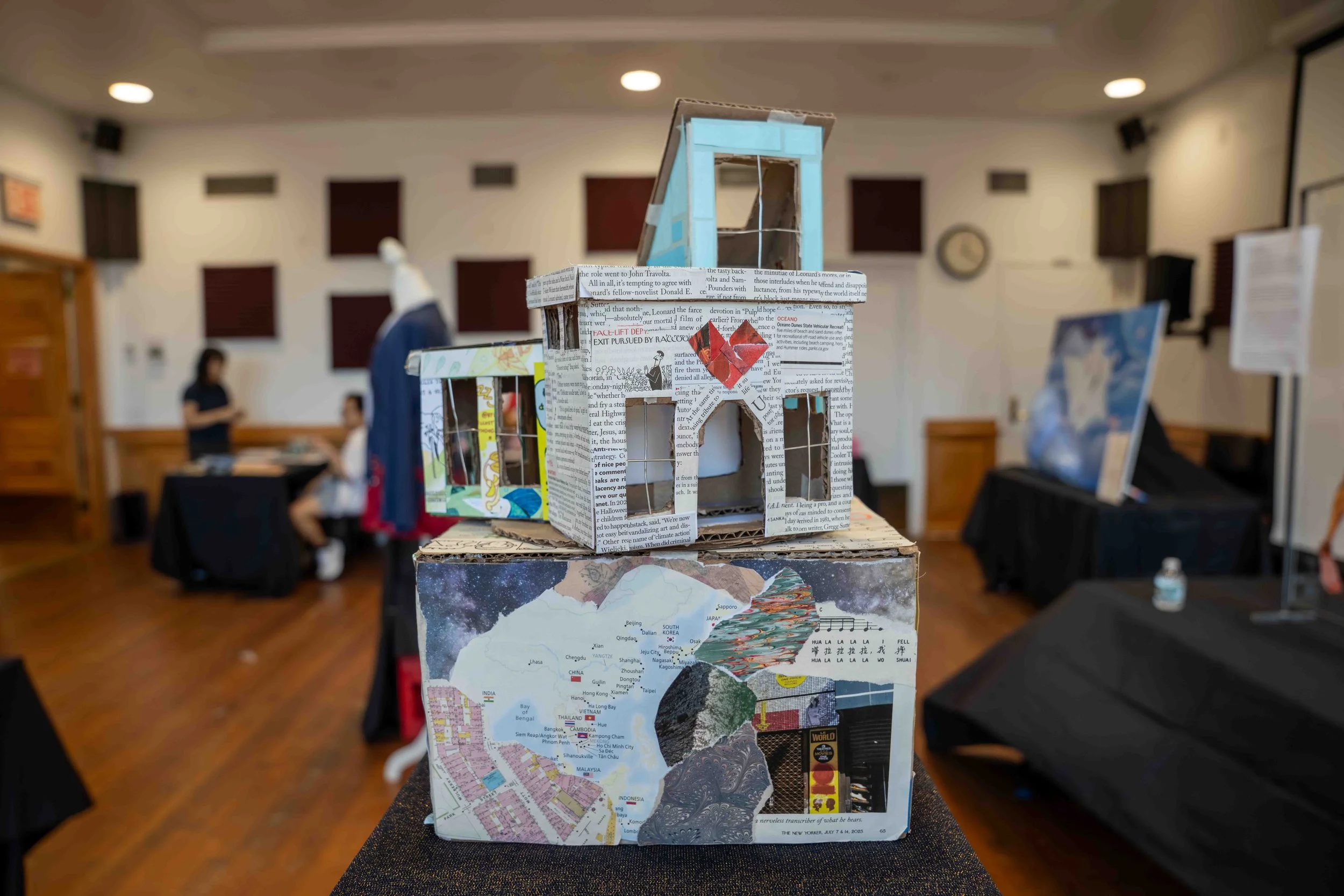
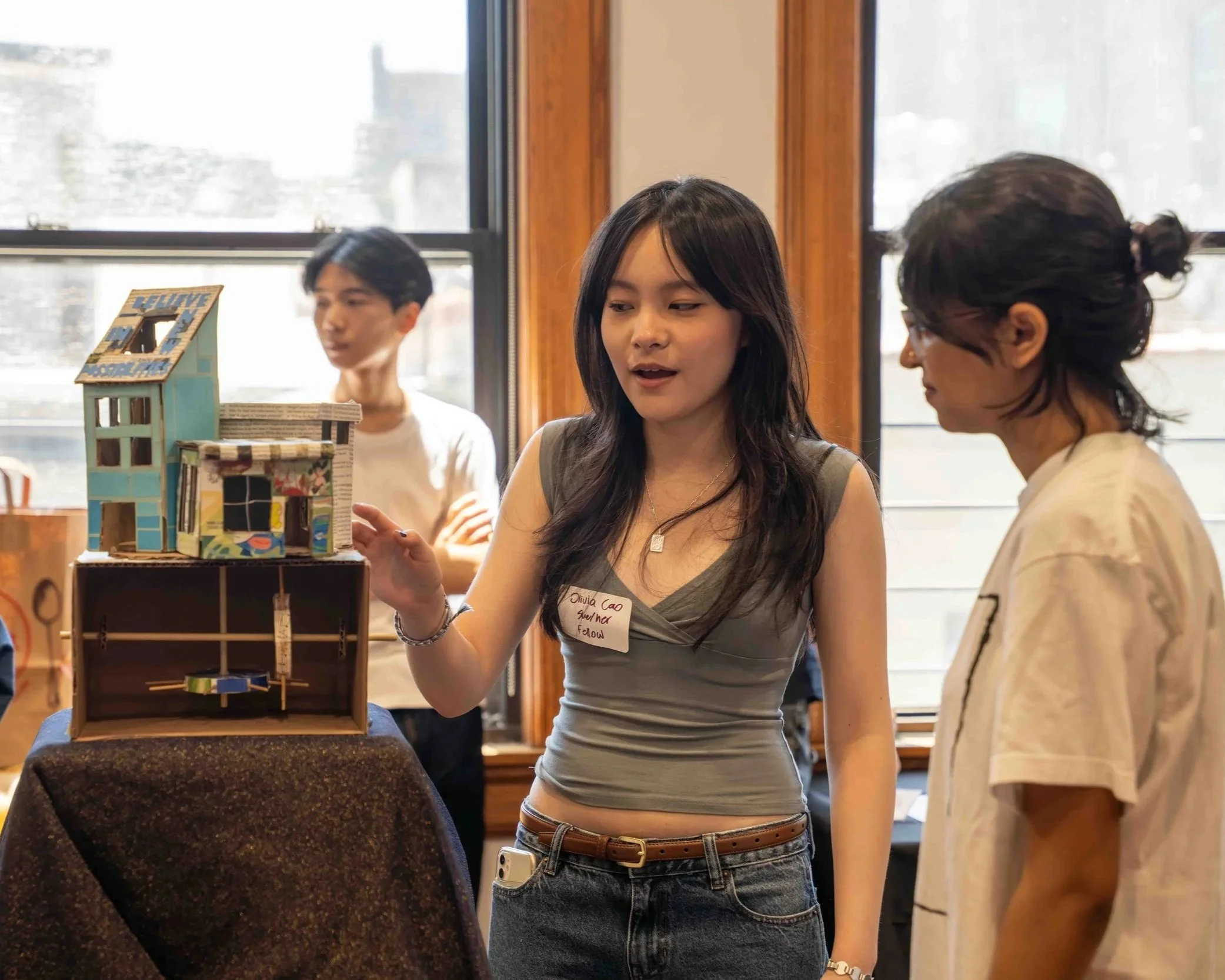
New Possibilities by Olivia C. (she/her)
Automata cam machine; 10in x 8in x 6in
My project was inspired by the lessons I’ve learned about prison abolition in RRR—and through further research, by how abolition is a vision for the future. Through my project, I wanted to envision a world without prisons: where people’s needs are met, and where safety and justice are preserved without violence.
I chose collage as one of my main mediums because of its abstract nature and freedom from realistic constraints. The base is an automata cam machine, with cardboard as the exterior and styrofoam and wooden dowels for the rotating parts on the inside. By using these seemingly unrelated materials together, I can create an entirely new reality.
All in all, I invite viewers to imagine the kind of world they wish to live in without fear that it is too unrealistic or unattainable. As Angela Davis puts it, abolition is a demand that we “believe in new possibilities.”
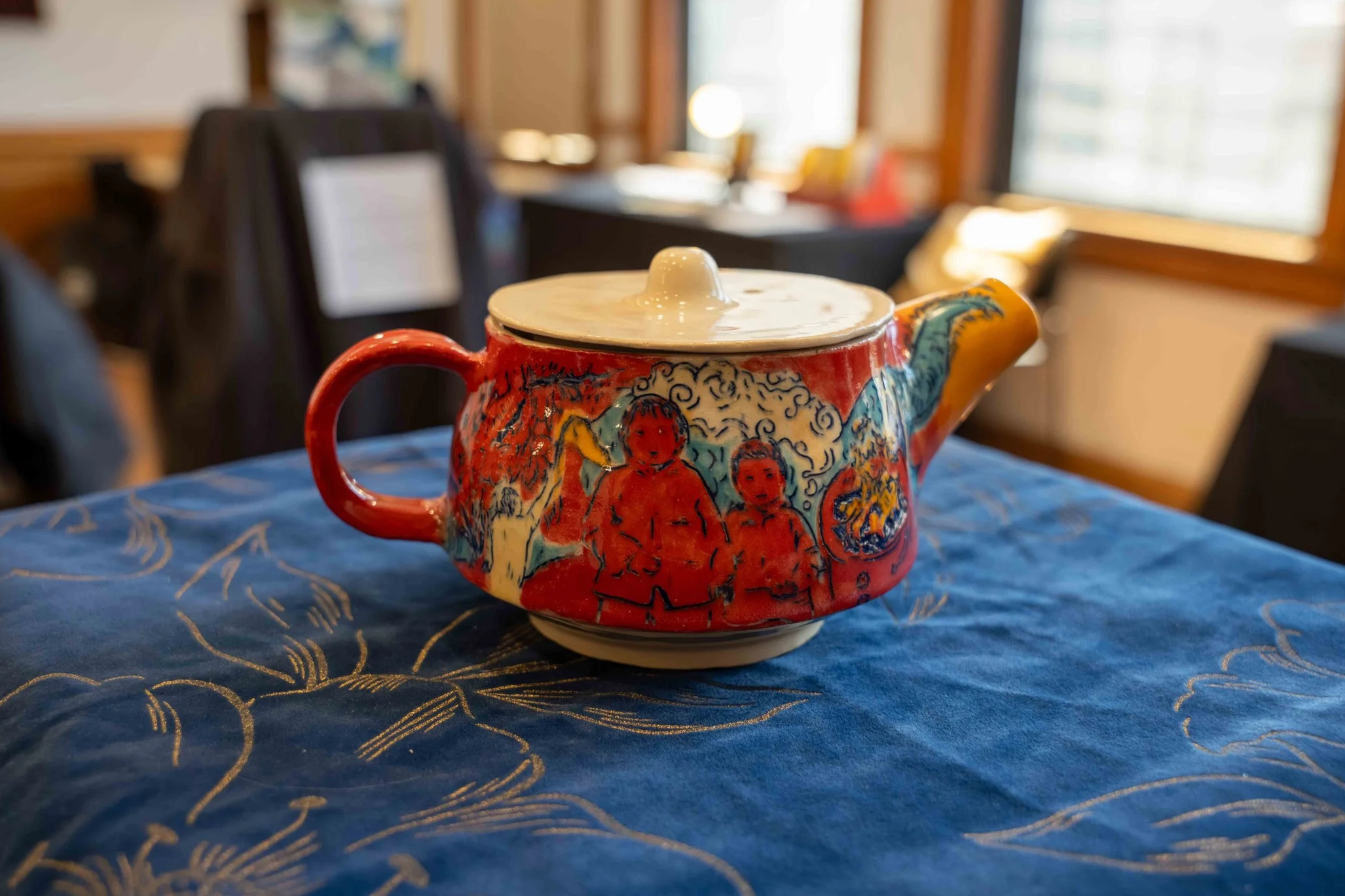
Memories Over Tea by Eileen W. (she/her)
Sgraffito on ceramic, 4”x 6”x 3”
Moved by the artist and activist Betty Yu’s practice of exploring and documenting her family’s past, I began my own journey of learning about my family’s history for my piece. My parents shared stories that were entertaining, surprising, but most of all nostalgic for the place they grew up in. My work records memories and highlights how deeply the places we live in shape our identities and the aftermath of change.
I blended together some of my favorite stories of my parents’ upbringing, with my own experiences living in Flushing, as well as scenes of my family’s attempts to close the distance between Flushing and Fuzhou. Just as my parents’ immigration prompted a shift in place, I reflect on how Flushing is transforming as a consequence of gentrification. I carve my memories so that the Flushing I know won’t be forgotten.
I worked on a teapot because of my dad’s rare but beloved rituals of sitting down, pouring tea, and talking. But I’ve realized that the presence of tea in my life has always been accompanied by loved ones, whether it's dim sum or my best friend’s tea parties.
Tea is meant to be shared with a community in Chinese culture, and at the forefront of placekeeping is protecting the community.
Thank you to RRR for your support and wisdom, and thank you to Yuki for making the teapot base.
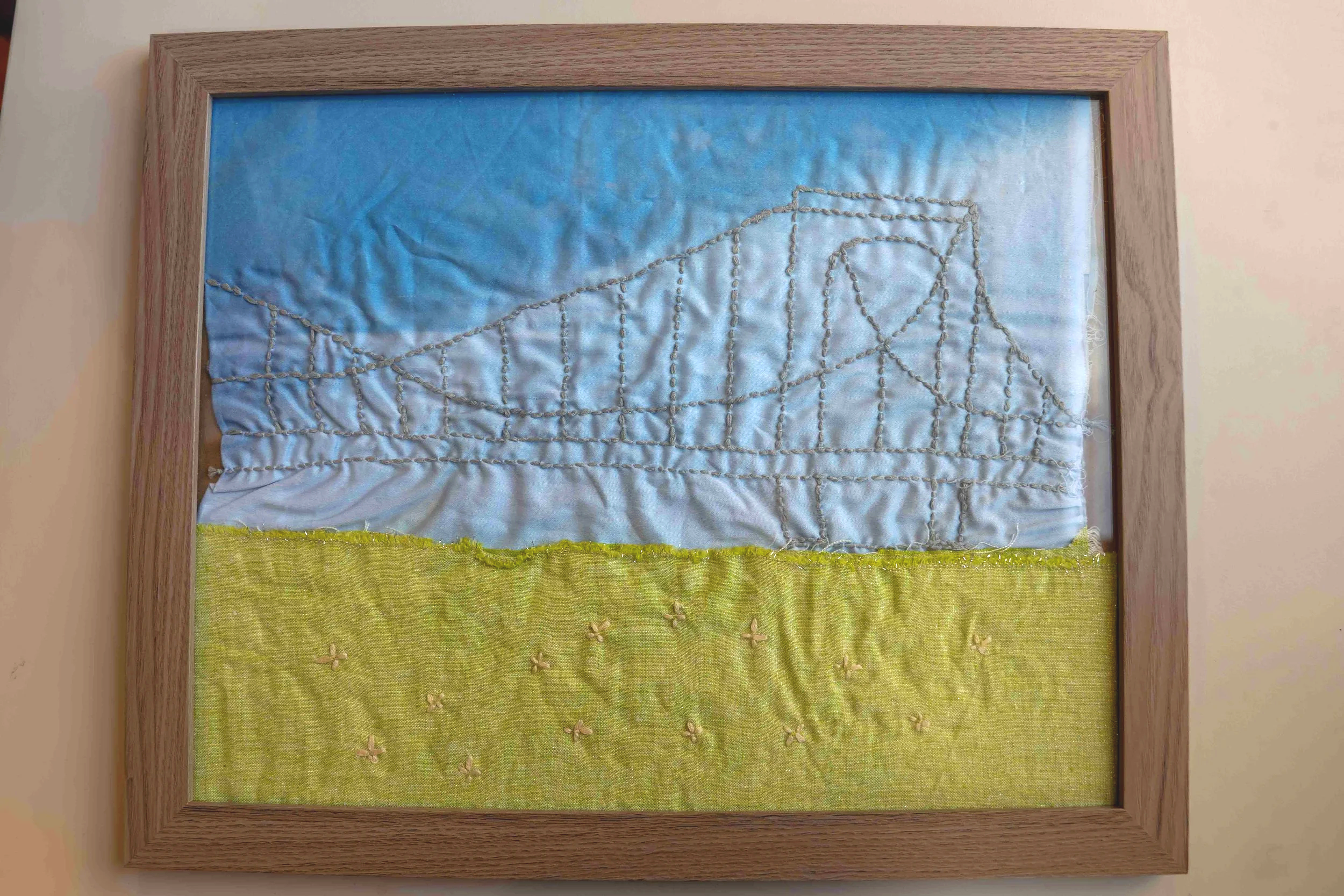
Pockets of Green by Cindy G. (she/her)
Embroidery on found fabric; 13.5” x 10.5”
Walking through the dense urban landscape of NYC’s Chinatown, finding pockets of green in the city is like a treasure hunt. Over the years, Chinatown has shifted from local businesses to rapidly growing developments. For instance, as a child, I used to frequent Pathmark, an essential grocery store, during my walks to Pier 35, surrounded by parks. As I walk by today, the same blocks have been replaced by commercial high-rise buildings.
Finding public green space amidst these commercial buildings is becoming increasingly hard. Yet, green spaces are essential for both the environment and the well-being of the Chinatown community. Green space is an area for people to exercise, move their bodies, and simply breathe fresh air. My embroidery piece juxtaposes the thick industrial threads of the Manhattan Bridge against delicate green patches of grass and golden flowers in bloom.
The Manhattan Bridge predates the Two Bridges neighborhood, yet the bridge has remained a longstanding landmark. This inspired me to preserve pockets of green to be as longstanding as the bridge. Just as the bridge connects people from all over NYC to Manhattan, pockets of green must similarly exist to anchor our community and offer a shared space for neighbors to gather and grow together.
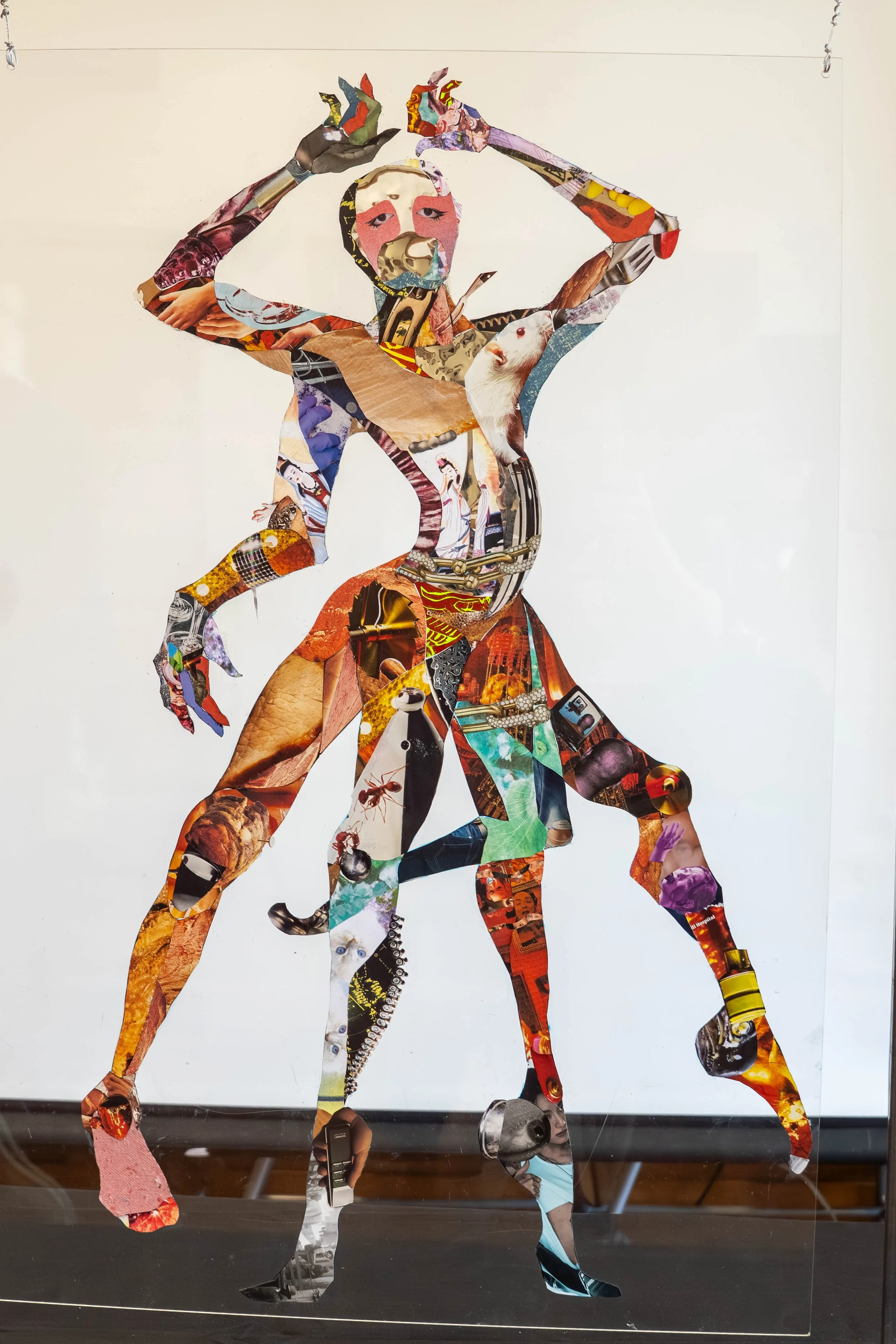
standard deviation byKai P. (he/him)
Collage on acrylic sheet; 24” x 36”
For my final project, I decided to think more deeply about my intersectional identity and the bodily realities of both Asian Americans and transgender/genderqueer individuals. My piece specifically explores objectification and fetishization of the trans and Asian body, drawing from a persistent history of Orientalism and the burgeoning perversion of transition as a transhumanist aspiration.
Through collage, I brought these themes into an ever tech-conscious modern reality, connecting the Western fear of transness and of the East as threatening forces of a dystopic technofuture. My inclusion of bugs and vermin across the body speaks to the modern phantasmatic view of trans identity as a contagion and of a deep-rooted history of Yellow Peril.
The many-limbed figure who appears to be phasing between unstable states of reality and identity calls Buddhist iconography to mind, as well as symbols of collective identity such as the Bharat Mata. The sectioning of the body also reflects scanning machines—key exponents of technological surveillance and policing of trans bodies—which deconstruct the body and assemble segments into a fabricated image. I positioned the figure to echo the pose one makes when going through airport security scanners, which flag “anomalies” on bodies along gendered lines, as well as encompassing the universal “hands up where I can see them” gesture.
Besides the reflective mylar, I collected all my material from magazines, pamphlets, and advertisements—sources that publish and commodify the body in one way or another. The process of pulling different images, textures, and colors from a multitude of sources greatly shaped the construction of the piece and the symbolism I included throughout the body
Invest in Chinatown's Next Generation of Creative Leaders
Your donation provides workshops, mentorship, and community projects that transform young Asian Americans into confident leaders capable of preserving and reimagining their community.